Baithak
How India’s Geography Shapes Traditional Textile Motifs


Introduction: The Landscape Woven Into Cloth
India’s textiles are not merely decorative — they are geographic records woven in thread. From the salt deserts of Kutch to the river deltas of Bengal, from dense forests in Central India to fertile riverbanks of the Deccan, India’s geography has quietly shaped the motifs, colours, and techniques seen in its traditional textiles. Every saree, shawl, or embroidered cloth is a map of its origin, carrying clues about climate, water, soil, vegetation, and lived culture.
At HAAT INDIA, we believe that to truly appreciate Indian handloom, one must understand where it comes from — not just who made it. This is the story of how India’s geography silently codes the patterns you wear. This article explores how India’s geography shapes traditional textile motifs across regions, climates, and craft traditions.
1. Coastal India: Fluidity, Fish & Flowing Forms
Regions: West Bengal, Odisha, Coastal Andhra Pradesh
Key Textiles: Jamdani, Sambalpuri, Baluchari
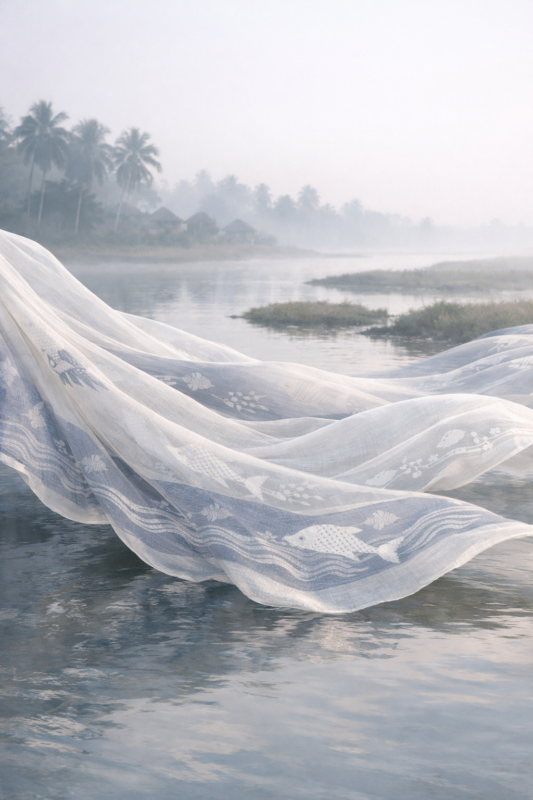
Motifs: Fish (Matsya), waves, flowing vines
Life along India’s coastline is governed by water — tides, rivers, humidity, and rainfall. It’s no coincidence that textiles from these regions favour curved, fluid motifs over rigid geometry.
In Bengal and Odisha, the fish motif is deeply symbolic — representing fertility, abundance, and prosperity. Beyond cultural symbolism, the environment plays a technical role. High humidity allows weavers to spin ultra-fine cotton yarn, enabling delicate, floating motifs seen in Jamdani sarees.
Kantha embroidery from Bengal rarely uses straight lines. The running stitch itself mirrors rippling water — a direct reflection of the ponds, rivers, and wetlands surrounding rural homes Motif.
Geography dictates not just what is woven — but how finely it can be woven.
2. River Belts: Lotus Motifs & the Chemistry of Colour
Regions: Andhra Pradesh, Telangana, Uttar Pradesh
Key Textiles: Kalamkari, Banarasi
Motifs: Lotus (Kamal), creepers, swans
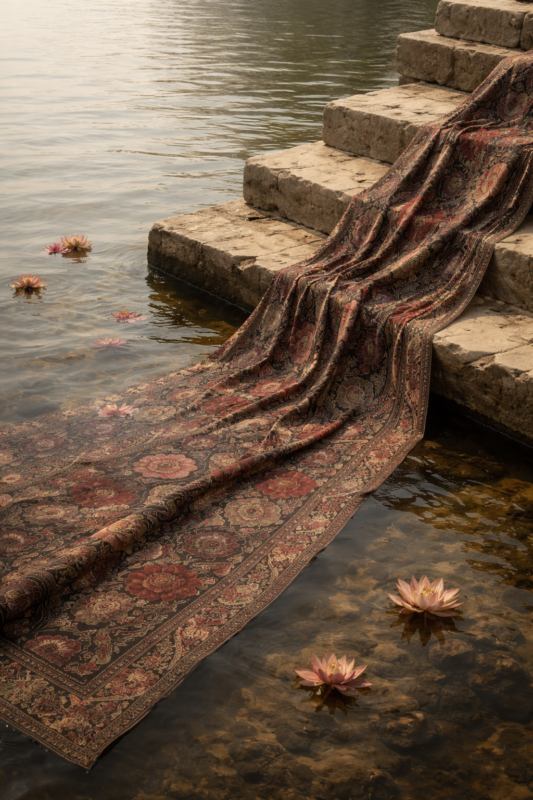
Civilizations grow along rivers — and so does symbolism. The lotus, blooming pristine from muddy waters, dominates textiles from riverine regions like Varanasi and Machilipatnam.
But this influence is not just poetic — it’s chemical.
Kalamkari’s iconic deep reds and blacks are made using natural dyes like Alizarin, derived from madder root. These dyes require mineral-rich river water to bond with fabric. Calcium and iron present in flowing rivers act as natural mordants, permanently fixing colour to cotton.
Stagnant water disrupts this process — which is why river flow itself determines motif clarity and dye sharpness Motif.
In Banarasi textiles, the abundance of water historically supported silk processing and complex brocade weaving — allowing dense floral patterns to flourish.
3. Forest Regions: Biomimicry, Animals & Identity
Regions: Central India, Odisha, Northeast India
Key Textiles: Tribal weaves, Banarasi Jangla
Motifs: Animals, dense foliage, Tree of Life
In forested landscapes, the horizon disappears. What surrounds the weaver is density — leaves, animals, shadows, and layered vegetation.
This gives rise to the “Jangla” pattern in Banarasi textiles — a literal translation of jungle into silk, with no empty spaces. Tribal weaves from Odisha and the Northeast use motifs inspired by elephants, birds, and foliage, dyed with forest-sourced materials like madder root and fermented iron.
In Nagaland, bold red and black stripes dominate. In dense forests where visibility is low, these high-contrast motifs functioned as identity markers — helping distinguish tribes instantly. Here, textile design moves beyond aesthetics into survival and social recognition Motif.

4. Desert India: Geometry, Contrast & Order
Regions: Kutch (Gujarat), Rajasthan
Key Textiles: Ajrakh, Bandhani, Patola
Motifs: Stars, dots, precise geometry
Why do deserts produce the most mathematically complex textiles?
Psychologists describe this as “horror vacui” — the fear of empty space. In vast, barren landscapes like the Thar Desert and Rann of Kutch, human creativity responds by imposing order.
Ajrakh textiles use precise symmetry, stars, and tessellations — often in deep indigo and rich black. The iconic “Ajrakh black” is created through fermenting iron scraps with jaggery, producing a ferrous solution that reacts with tannin-treated cloth to create intense contrast.
In blinding desert sunlight, subtle colours disappear. High contrast becomes essential — which is why desert textiles favour bold geometry and saturated hues Motif.

Several Indian textile traditions are also recognised by UNESCO for their cultural significance and continuity.
A Map Woven in Thread
Together, these patterns reveal how India’s geography shapes traditional textile motifs through land, water, and climate. Across India, geography determines:
- Motifs (fish, lotus, animals, geometry)
- Colours (river-fixed reds, forest blacks, desert indigo)
- Techniques (fine spinning, resist dyeing, dense brocade)
- Materials (cotton, silk, natural dyes)
Traditional Indian textiles are not random artistic expressions. They are environmental intelligence passed down through generations.
Why This Still Matters
In a world increasingly disconnected from origin, Indian textiles remind us that beauty once came from listening closely—to land, to material, to limitation. When craft is removed from its geography, it becomes surface. When it remains rooted, it becomes story.
e believe cloth deserves to be read as carefully as it is worn. Because every thread remembers where it came from. And if we pay attention, it tells us.
At HAAT INDIA, every product is sourced directly from its place of origin — because geography is not a detail. It is the design language itself.
👉 Explore region-wise authentic Indian textiles and crafts at www.haatindia.in
On sale products
-
Bolpur – Blue Floral and Vine Motif Khesh Cotton Kantha Saree
Original price was: ₹ 4,600.₹ 3,680Current price is: ₹ 3,680. -
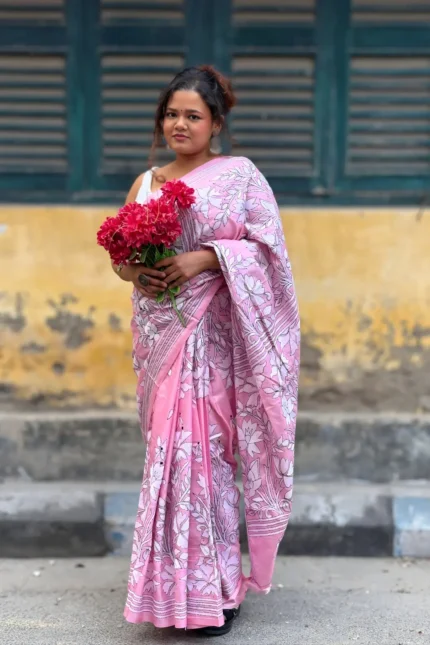
Bolpur – Blush Pink Floral Silk Nakshi Kantha Saree
Original price was: ₹ 8,990.₹ 8,541Current price is: ₹ 8,541. -
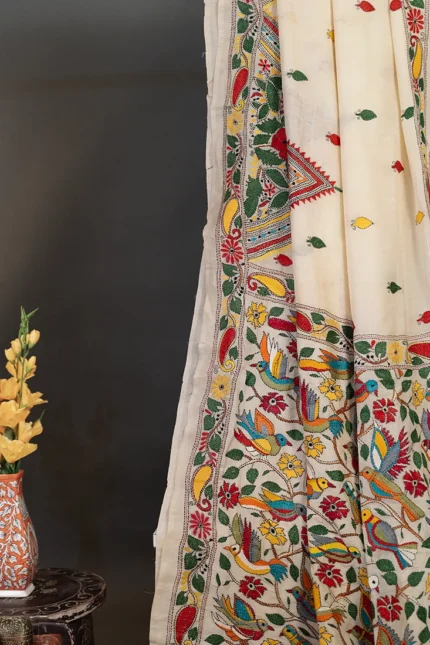
Bolpur – Hand-Stitched Beige Bird Motif Nakshi Kantha Saree
Original price was: ₹ 14,990.₹ 14,240Current price is: ₹ 14,240. -
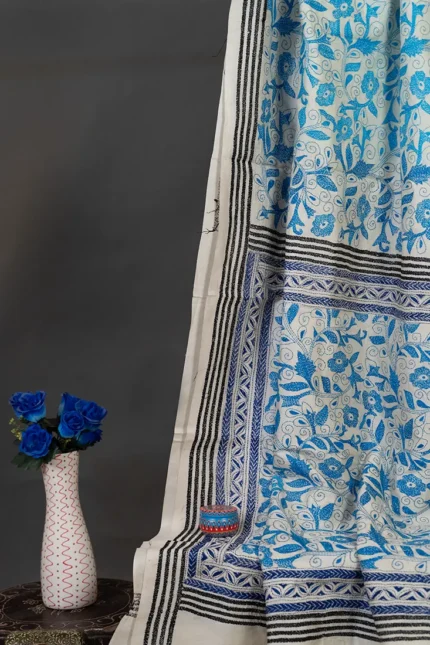
Bolpur – Hand-Stitched Beige Blue Floral Motif Nakshi Kantha Saree
Original price was: ₹ 14,990.₹ 14,240Current price is: ₹ 14,240. -
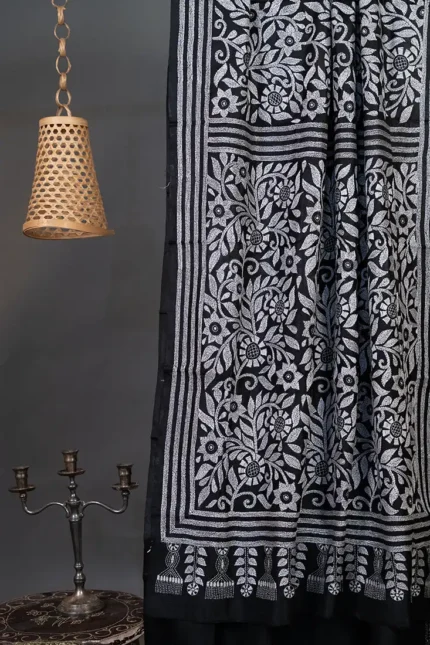
Bolpur – Hand-Stitched Black White Floral Nakshi Kantha Saree
Original price was: ₹ 14,990.₹ 14,240Current price is: ₹ 14,240.